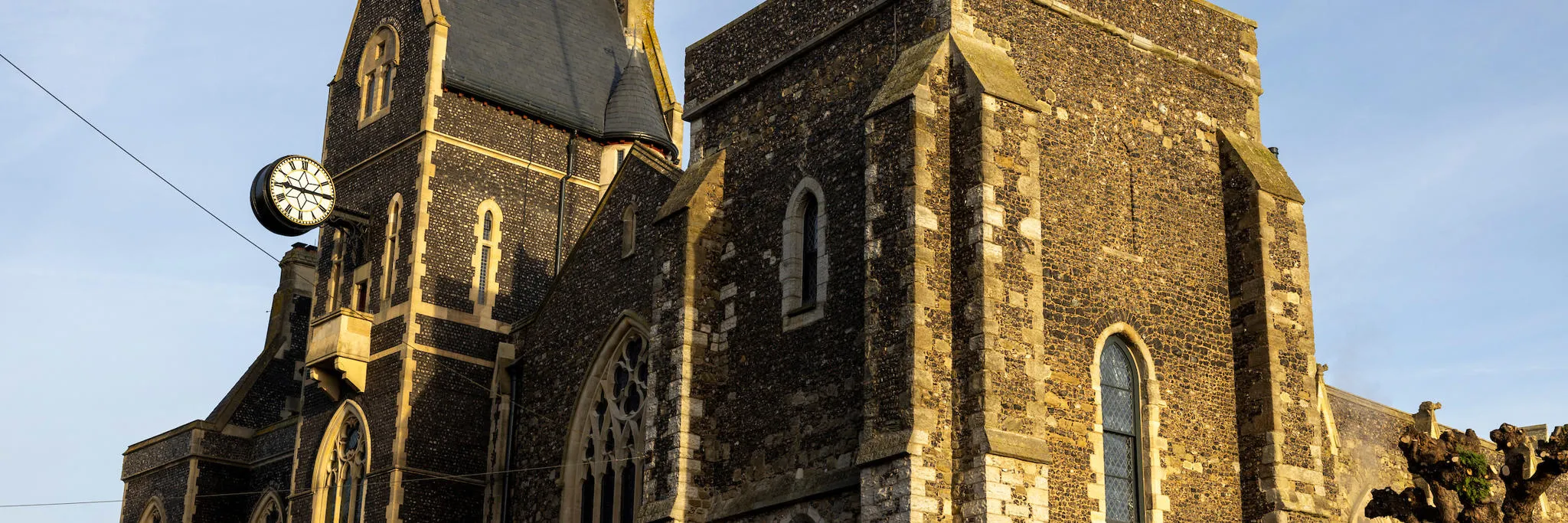
The Maison Dieu (Dover Town Hall)
The Maison Dieu was founded in about 1200 as a place of hospitality for pilgrims travelling to and from the Continent. After the Reformation, it became a victualling yard, making salt meat, ships biscuit and beer for the Royal Navy, before taking on a new role as Dover Town Hall in the 1830s. Today it’s a popular events and heritage venue.
Much of the Maison Dieu we see today is the vision of William Burges, who worked on the building twice when it was Dover Town Hall.
He was first involved between 1859-61 when he completed Dover architect Ambrose Poynter’s plans for the re-imagining of the Stone Hall in the medieval style, after Ambrose lost his sight.
He added impressive Neo-gothic details, such as carved animal grotesques, heraldic shields and stained-glass windows.
Burges returned in 1881, when he completed plans for a major extension to the building, which included a large assembly room and Mayor’s Parlour.
Although he died shortly afterwards, his scheme was completed by his dedicated work team, supervised by John Starling Chapple and Richard Popplewell Pullan and opened in 1883.
Its breath-taking decorative scheme, rediscovered under layers of more recent paint, was re-instated in 2024 by wall paintings specialists Arte Conservation.
The scheme also included civic furniture, including a monumental Mayor’s Parlour table and set of chairs with lion-head carvings.
The Maison Dieu is the only civic building Burges worked on, where his original architecture, decorative scheme and furniture survive.
Entrance Foyer
To make the Maison Dieu fully accessible, and with the permission of Historic England, a new ground floor entrance was created on Dover High Street in 2024.
This required the removal of a window from the 1883 Burges extension.
Excitingly, several blocks of stone removed from the window surround included Victorian masons’ marks.
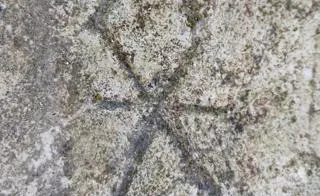
Masons’ marks
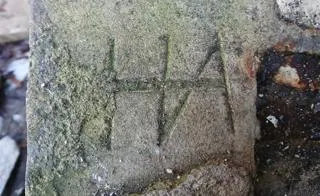
Mason's Mark - HA
Connaught Hall
The Connaught Hall (named after the Duke and Duchess of Connaught) was built as an assembly room and opened in 1883. The duke was the third son of Queen Victoria.
Plans for a major extension to the Maison Dieu (Dover Town Hall), which included the Connaught Hall and Mayor’s Parlour, were drafted by William Burges shortly before his death in 1881, and the work completed by his dedicated team.
This impressive space has been used for a wide variety of functions, from dances and concerts to election counts, beer festivals and wrestling. It is still an important events venue today.
The original decorative scheme, discovered under layers of modern paint, was re-instated in 2024 by a dedicated team of wall paintings specialists from Arte Conservation. The intricate, stencilled design includes gilded flowers, birds and dragons.
In 1899, Guglielmo Marconi’s wireless (radio) technology was successfully demonstrated in front of a packed audience, with the first two-way Cross-Channel radio message transmitted to France and back.
Winston Churchill gave a speech from the stage, thanking the people of ‘Fighting Dover’ for their important contribution during the Second World War.
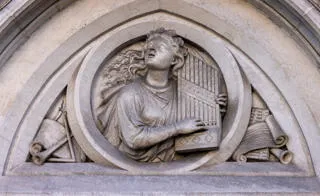
Saint Cecilia and Connaught’s Music
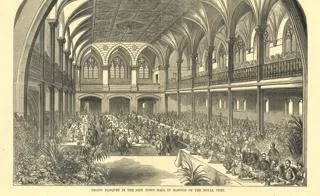
Grand Banquet
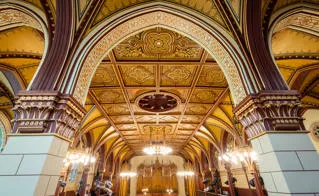
Connaught Hall gilded ceiling
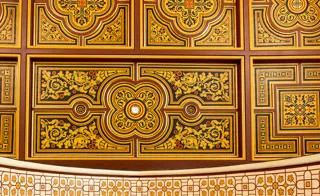
Doves Taking Flight
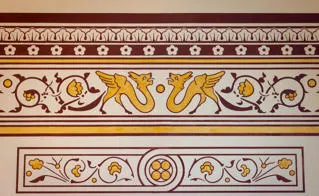
There be dragons
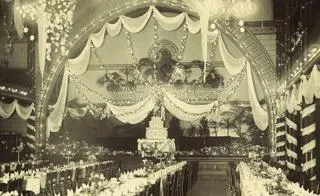
The Connaught Hall balcony and proscenium arch
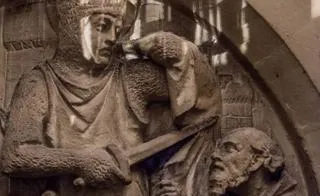
A hidden carving of St Martin
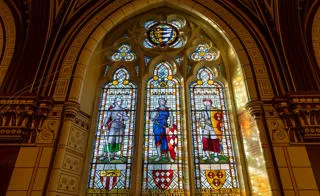
Stained-glass Constables of Dover Castle
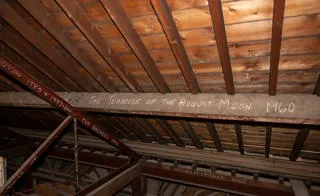
Pantomime graffiti
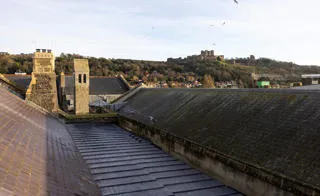
View from the roof
The Clock Tower
The Maison Dieu Clocktower, designed by William Burges in 1881 contains some impressive hidden secrets.
Ascending the narrowest of spiral staircases, from a landing on the Connaught Hall balcony, the intrepid explorer emerges into a small room, empty except for an intriguing structure, part cupboard, part mini-house, with a low-pitched roof and a set of double doors.
This is the housing, that protects the clockwork mechanism of the Maison Dieu bracket clock, which juts out from the front of the building and has told the time to passing Dovorians for almost 150 years.
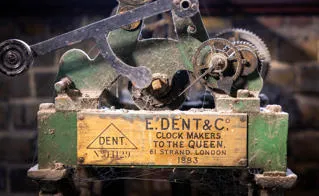
Clock this!
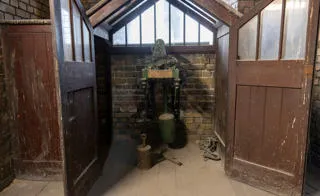
Clock mechanism housing